Remember when tariffs were just a headline and not a volatility index?
Yeah, me neither.
Trump’s back with the trade-war playbook, this time updated with sharper elbows and fewer filters. Markets have gone from mildly annoyed to outright allergic to anything that smells like protectionism. In the background, the new guy at Treasury, Scott Bessent, is quietly building a liquidity cannon. He is pretending everything’s normal.
Spoiler: it’s not.
This isn’t your typical “rate cuts are coming” hopium essay. This is a deep dive into how global liquidity — not press conferences — will determine where Bitcoin’s headed next. And why it may not just go up. It might explode.
Let’s get into it.
We’re in one of those moments right now.
Not because the Fed’s cutting rates. Not because an ETF got approved. Not because of a strategic reserve. And definitely not because the market has “priced it in.”
It’s the convergence of three monetary superpowers: the U.S. Treasury, the Federal Reserve, and the People’s Bank of China. All three are sliding, simultaneously, into different forms of stealth easing. Each trying to look calm on the surface. Underneath? Full panic mode. And together, they’re about to light the fuse under Bitcoin’s next explosion toward $200,000 and beyond.
This isn’t hopium. It’s liquidity math.
The Treasury’s Hidden Leverage Engine
The U.S. Treasury isn’t just funding the deficit anymore. It’s actively propping up the bond market by enabling more leverage under the hood. The mechanism: Treasury buybacks.
Buybacks sound harmless. Issue one bond, use the proceeds to buy an older one. Net debt stays flat.
But markets don’t care about net debt. Markets care about flow. And buybacks change everything.
They free up capital in a part of the market most people overlook: hedge funds running the Treasury basis trade.
What the Hell Is the Basis Trade?
Here’s the primer.
The basis trade is a leveraged arbitrage strategy. Hedge funds go long a cash Treasury bond (usually off-the-run), and short a Treasury futures contract referencing the same maturity.
They profit from the spread. Sounds simple. The catch? They use massive leverage. Sometimes 50x or more.
The repo market funds the long side. The futures leg is margined through exchanges. It works—until volatility spikes.
Then come the margin calls. Liquidity evaporates. Positions unwind in panic.
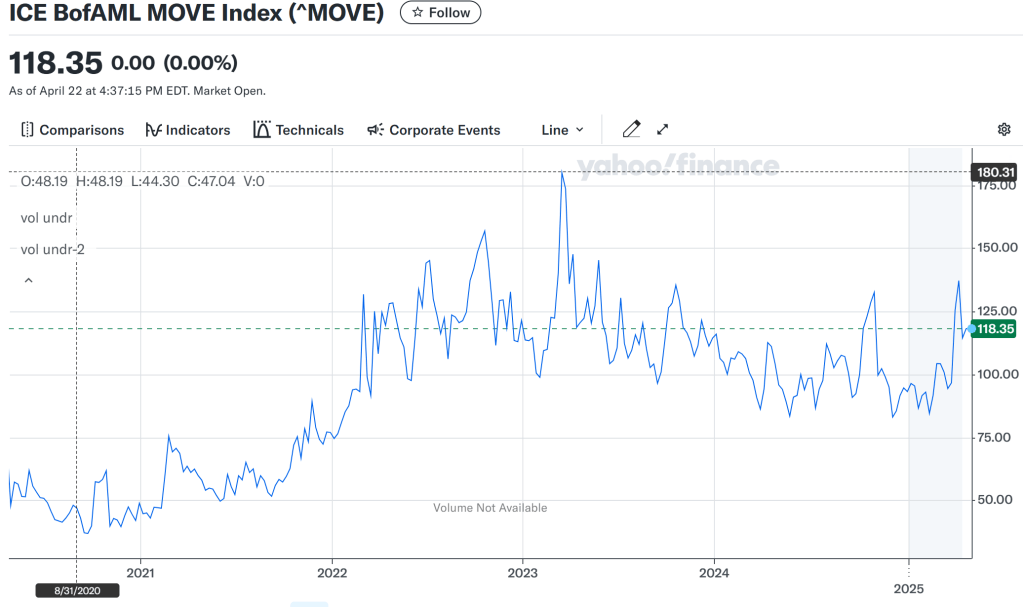
We’ve seen it before. It happened during the SVB collapse in 2023. It occurred again in late 2024 when the MOVE Index went vertical.
Now factor in the Treasury’s buybacks.
By purchasing off-the-run bonds, Treasury boosts their prices. That narrows the basis, makes the trade more profitable, and reduces volatility. Lower volatility means lower margin requirements.
Suddenly, hedge funds have room to breathe. They re-leverage into new auctions. Liquidity builds. And the whole system stabilizes—without the Fed having to print a single dollar.
The Fed’s Not-Easing Easing
Powell’s still playing the “we’re not easing” game. But the March FOMC told the real story: QT was slowed.
That was the first signal.
Next comes the likely QT twist. Let mortgage-backed securities roll off, but reinvest proceeds into Treasuries. Balance sheet stays flat. Sovereign bond demand gets a boost.
This kind of shift doesn’t hit headlines. But markets feel it.
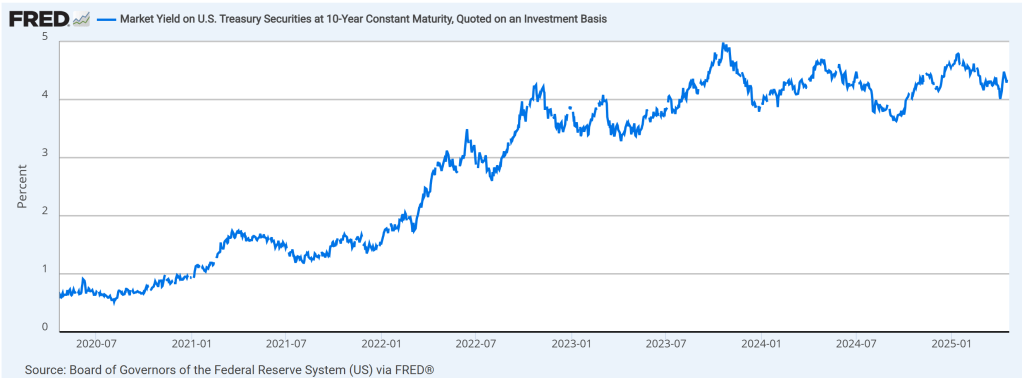
It supports Treasury auctions, suppresses yields, reduces volatility, and helps the basis trade. That, in turn, creates the conditions Bitcoin thrives in. You can see below the 10Y yield has been out of control for quite some time.
The Biden Treasury Liquidity Era
During the Biden administration, liquidity didn’t just come from the Fed.
When Powell was tightening hard in 2022–2023, it was the Treasury—not the Fed—that quietly re-liquefied the system. There were two major plays:
- TGA Drawdown (2023):
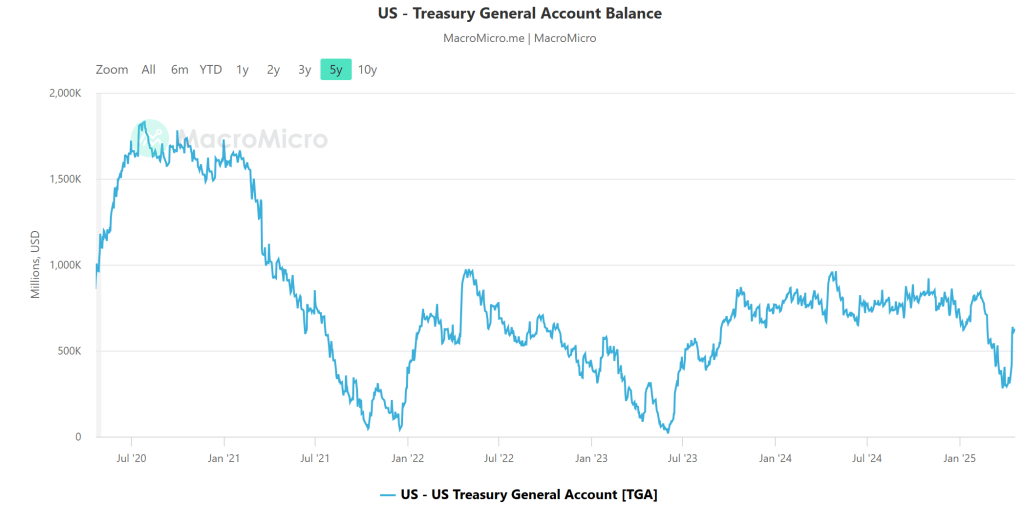
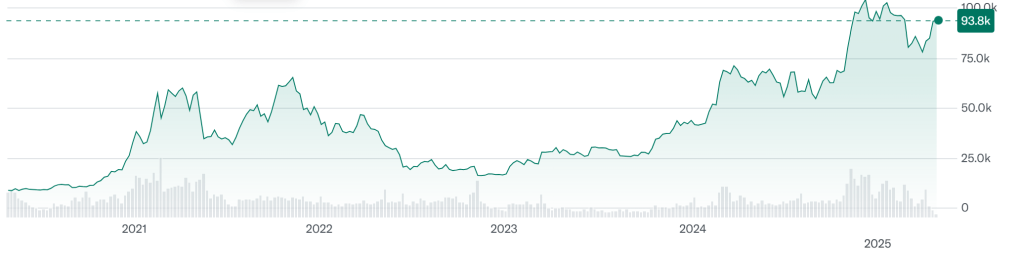
After the SVB failure, the Treasury sharply cut its cash balance at the Fed (the TGA). By spending down the TGA, dollars were released into the banking system. This was liquidity-positive, even as the Fed continued QT. Bitcoin surged from $25K to over $70K during that run. - Bill Issuance (Late 2023 – Early 2024):
The Reverse Repo Program held over $2 trillion in idle liquidity. Yellen issued short-dated Treasury bills to soak it up. This move didn’t expand the deficit but shifted liquidity from sterilized cash into tradeable bonds, effectively reactivating it.
These weren’t labeled as QE. The effect was similar, though. It included reduced financial stress, compressed yields, and a powerful tailwind for risk assets. Bitcoin was especially affected.
When the U.S. Treasury draws down its General Account (TGA), it injects liquidity into the system. Dollars move from the Fed to the private sector. This frees up capital, boosts risk appetite, and often fuels Bitcoin rallies. A rising TGA, on the other hand, pulls cash out of circulation, tightening liquidity and acting as a short-term headwind. In short: TGA down = bullish for BTC.
You can see here that when TGA was drawn down, BTC ripped.
BTC during the same time frame below.
China’s Quiet Flood
Meanwhile, the People’s Bank of China (PBOC) is quietly easing to avoid a debt spiral. They’re cutting reserve ratios, injecting liquidity, and massaging credit markets to keep things from breaking.
The liquidity doesn’t always stay home.
Wealthy Chinese investors are increasingly looking for ways to get capital out. They’ve seen what happens when local assets collapse. They want safety, mobility, and upside.
That flow ends up in gold and Bitcoin.
With the yuan softening and policy still loose, Bitcoin becomes the pressure release valve for China’s slow-motion stimulus.
As of April 2025, the PBOC has intensified its liquidity injections. This move counteracts economic pressures. It also addresses escalating trade tensions. In March alone, the PBOC injected 800 billion yuan ($110 billion) into the banking system through outright reverse repurchase agreements. This marked the smallest net injection since the tool’s start in November last year. (Reuters)
Simultaneously, China’s M2 money supply—a broad measure of money in circulation—has reached a record 326.06 trillion yuan ($44.7 trillion) by the end of March, reflecting a 7% year-on-year increase. This surge in liquidity indicates the government’s commitment to maintaining ample financial system liquidity (ECNS).
However, these measures coincide with significant capital outflows. In 2024, China’s net capital outflows reached $486 billion. This was the highest level in eight years. It highlights growing concerns over the country’s economic stability. BNP Paribas Economic Research Analysts warn that such outflows could compromise financial stability, a scenario Beijing aims to avoid.
In summary, expect the PBOC to print. Brrrrrr!
Volatility, Leverage, and Forced Intervention
The MOVE Index keeps spiking. That’s a problem.
Because a massive share of Treasury demand now comes from leveraged players. If volatility stays elevated, margin requirements rise. Basis trades get unwound. Auctions get dicey.
This creates the exact conditions that force policymakers to intervene.
They don’t want to call it QE. They don’t want to trigger political blowback. But they will suppress volatility, enable leverage, and keep the bond machine running.
They have no choice.
And Bitcoin knows it.
Why Bitcoin Catches the Bid
Bitcoin isn’t waiting for a Fed rate cut. It front-runs liquidity.
When volatility spikes, policy pivots. When pivots happen, new liquidity enters the system. When new liquidity enters the system, Bitcoin rips.
It’s the cleanest asset in the world to store the marginal dollar. It’s global. It’s liquid. It doesn’t rely on counterparty trust. And it thrives in environments where fiat is being quietly diluted to keep the machine running.
This isn’t about collapse. It’s about survival.
And survival requires more liquidity.
Bitcoin Isn’t Just a Tech Trade Anymore
A lot of people still think Bitcoin is just a high-volatility version of their favorite AI stock. That it pumps when tech stocks pump, and dumps when the S&P sneezes.
That phase is ending.
Bitcoin trades liquidity, not earnings. Right now, liquidity is injected into areas stocks can’t fully capture. This occurs through Treasury buybacks, RV fund leverage, and foreign capital leakage.
Meanwhile, equities are stuck. Valuations are stretched. Earnings are soft. Tariffs are looming. And policy doesn’t help stocks the way it used to. The Fed can slow QT, but it’s not cutting fast enough to juice multiples.
Bitcoin doesn’t need margin expansion or GDP growth. It just needs fiat. And fiat is leaking into the system in massive, sneaky ways.
So when stocks stall, and Bitcoin still pushes higher — that’s not a fluke. That’s the new trade.
Bitcoin is carving out a new identity as a sovereign liquidity hedge, not a tech tag-along.
If the MOVE Index drops, and basis trade leverage expands, and Treasury buybacks increase — Bitcoin rips.
Even if stocks go nowhere.
Especially if they do.
$200K Isn’t a Meme, it’s Coded
Back in 2020, Bitcoin went from $10K to $60K when central banks opened the floodgates.
In 2023, it went from $25K to $73K off the back of a QT pause and liquidity injections post SVB.
Now we’re here.
QT is already slowing. Treasury buybacks are ramping. China is easing. Japan’s still at zero.
The next liquidity wave is building. It doesn’t need a headline. It just needs to keep flowing.
Bitcoin front-runs that flow.
$200K is just the spillover.
How You’ll Know It’s Happening
If this thesis is right, you won’t need a Fed presser or a Bloomberg headline to tell you.
You’ll see it in the flows.
Here’s what to watch in the coming weeks and months:
- MOVE Index falls – Bond volatility cooling down = basis trade leverage coming back online. That’s bullish liquidity, even without a rate cut.
- Treasury buybacks ramp – If Bessent increases the pace or scale of buybacks, the Treasury enables leveraged absorption. This absorption applies to upcoming debt issuance.
- QT slowdown or Twist – If the Fed begins reinvesting in Treasuries, the writing’s on the wall. Stealth easing is underway if the Fed announces a composition shift (MBS → UST).
- TGA drawdown or net positive bill issuance – The Treasury is using its cash account or bill-heavy issuance mix. This means liquidity is entering the system. This liquidity comes especially from RRP.
- China’s M2 and FX Reserves – If China continues printing, the yuan may weaken. Watch for offshore Bitcoin volume to spike. That’s capital flight through crypto.
- BTC vs. Nasdaq divergence – Stocks may chop sideways or trend lower. Meanwhile, Bitcoin pushes higher. The market is telling you two important things. First, this isn’t just about risk-on. Second, it’s about liquidity-on.
The confirmation won’t come from a press release.
It’ll come from price.
If Bitcoin reclaims $100K before any formal policy pivot, you’ll know this thesis wasn’t just macro fantasy.
Final Word
Don’t get distracted by the inflation debate or headline CPI. Focus on what matters.
-Are policymakers suppressing volatility?
-Is the Treasury helping funds re-leverage?
–Is global liquidity rising under the surface?
If the answer is yes, Bitcoin will run.
This isn’t about collapse. It’s about what happens when the financial system needs more fiat to keep functioning.
Bitcoin is the bid for that outcome.
And it’s already begun.
 SuveerSolutions
Leave a comment